I once created a cooking class, called 'Zen in the Kitchen'. Then wrote a book called the same. Then started the group with that name and the blog came after. All this happened in Turkish. Now is the time for the English version of it. Let's see what will cook here!

Wednesday, March 08, 2006

Turkish breakfasts

This morning, I got up early. Even if it wasn’t cold outside, I decided to stay in bed and share the joy of birds. I decided if I stay in bed and keep quiet, I wouldn’t disturb their morning ritual.

Then I heard a voice coming from far away: “simitçiiiiiii”. It was the voice of our neighborhood’s early bird. The ‘simit seller’. He’s one of the few simitçi’s who pass from our street every morning. Immediately, I rose up from bed, opened my window to morning. The cherry tomatoes I got from the farmer’s market yesterday, a ready to eat avocado, ‘örgü peyniri’ (a special local cheese from the Eastern part of Turkey)

and my green olives would be a perfect match for a simit. Unfortunately when I get dressed and reach to the balcony, he was walking away. I thought another one would come but no, none came after him. So I had to go to the local market to buy two simits. One for me, one for mom. I prepared the tea, cut the tomatoes and prepared the rest of the breakfast.
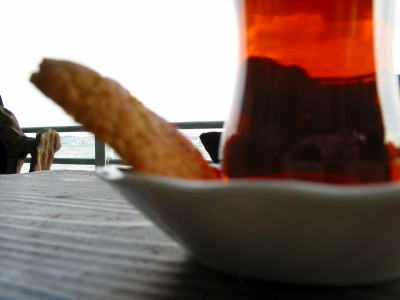
Breakfast is important for us, Turks. We want our tea (not a teabag, real, brewed tea for our breakfast. One glass wouldn’t be enough. We don’t enjoy large mugs for tea. It should be glass with a thin belly which keeps the tea hot. With tea, cheeses, butter, olives and jams are served. At times (depending on the season) tomatoes, cucumbers, peppers, even parsley and fresh greens are added.
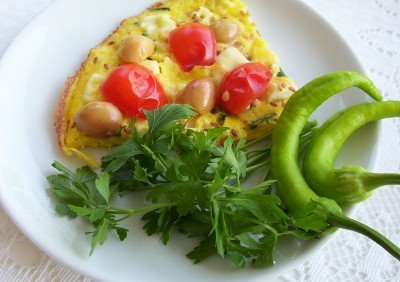
Omlette is not a must but be present on the weekend breakfasts. It could be eggs with ‘sucuk’ too. Sucuk is similar to sausage in a way. Ground meat mixed with some spices and garlic is filled in dried, cleaned intestines and let be dried for sometime. It used to be made at home in the past. Some families still make it I guess but it’s not made at our house anymore. I don’t eat it since I don’t eat meat but ‘sucuk’ is a beloved breakfast companion for many Turks.
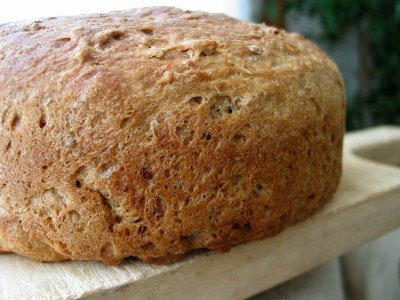
Breakfasts won’t be ready without breads. It could be homemade bread or bread from the baker. It could be white and sponge like or brown and tough. It depends on your taste and decision but we love bread! Yes, we may prefer ‘simit’ to bread at times but we don’t have simit for breakfast everyday, don’t worry. Were breakfasts be like that fifty years ago? No, soups would have been eaten in many households. With a ‘tarhana’ or ‘mercimek çorbasi’ (lentil soup), homemade filo pastry would be served. Cheese? Yes, at some houses. Olives and oliveoil? Yes, if you live in the Aegean region. Butter and jam? Not jam at so many places but tahini and pekmez (grape molasses) mixture would be great for winter!
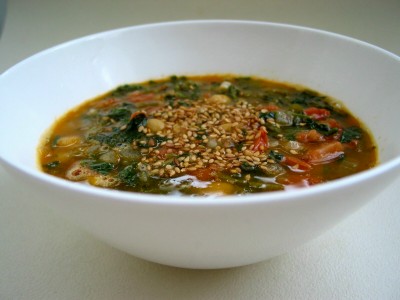
In each region, the breakfast tradition is different. It totally depends on what you have on hand or what you grow or can prepare. If you have sheep, cows or goats, cheese would be a part of your breakfast. If you own chicken, boiled or cooked eggs would be for breakfast. Soup is still preferred at some regions but it can be served with cornbread in the Blacksea region where wheat bread would be at hand in the central Anatolia. So much could be added to this breakfast issue but let me add the pictures to speak for it…

This pastry is made by my friend Sema few weeks ago for breakfast. It’s called ‘cantik’ and is made by Tatars mostly. It’s filled with mashed and spiced potatoes (normally a meat filling is preferred) and made with wholewheat flour. It’s made with white flour by many women.

This actually was a lunch photo but it could be eaten for breakfast too. I took this last summer when we visited an oliveoil factory in Edremit (a Northeastern Aegean town). We had olives and oliveoil, the bread came from a nearby village, cheese from around and tomates were from the garden. It was a great lunch if you ask me. I could eat it for 3 times a day in summer!
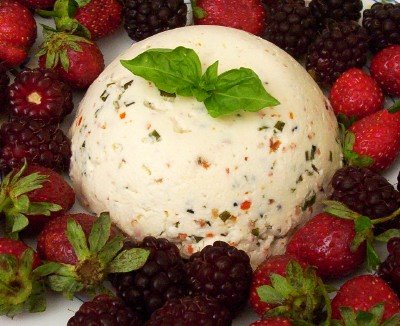
This is a ricotta-like homemade cheese. We don’t normally serve cheese with fruits and fruits are not a usual breakfast item but I like making that cheese with herbs and dried tomatoes. In Turkey an easy to made cheese, ‘çökelek’ is made at many houses. You might have heard making cheese by adding a bit of sour element (either lemon juice or vinegar). That’s how I made it. (If you want the recipe of this cheese, please visit yogurtland where you can find it.)
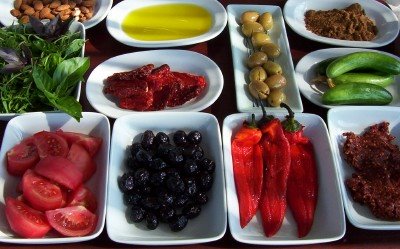
This is one of my favorite breakfasts. I have it once in a while and cannot forget. My friends own a boutique hotel on the Ida mountains. Their chef (and one of the owners) Erhan is a talented chef. He and his sister Menend prepares one of the greatest breakfasts of the region. You might want to experience it yourself. For more info check their website: www.zeytinbagi.com

WOULD YOU LIKE TO SHARE YOUR OWN BREAKFAST IDEAS WITH US?

Friday, February 24, 2006

The Tourism Fair of Istanbul

Today is the second day of EMITT Tourism Fair in Istanbul. I was lucky to be there yesterday, on its first day. This is my favorite fair (although I don't like fairs, I try not to miss this one) because that's the place where you can see many tastes, colours and people from so many different regions. The western, eastern, southern, northern... Anatolia is a place where you can experience different life styles. Too much is happening day by day. Weddings, celebrations, mournings... And each one of it has different kind of food. I hold a 'kömbe' on my hand, which is a special pastry (lets say cookie) made for special occasions. For ex. a religious holiday is a time when kömbe is made. The one I'm having at this moment is from Osmaniye, a southern city in Turkey.

I wish I had more time to write more in English but I realized that traveling that much doesn't help when it comes to writing in a foreign language. I know readers want frequent changes in this kind of sites. It's more like a journal and I've realized that I don't use this blog as a journal since it needs real concentration. So for this time I'd like to offer the photos I took at the EMITT Fair where you can see dried chestnuts from Ayancik; a sandalwood ornament from Osmaniye; first green almonds from Datça; snowdrops from Poyrali, Kirklareli; narcissus flowers from Karaburun, Izmir; a sweet from Gümüshane; dolls from Batman... I hope to write more soon for the English speaking readers of this site. Have a good and springy day.

Saturday, January 28, 2006

Wild greens of Turkey and the "simit" trio


I once wrote an article called 'Onion to your left and garlic to your right'which
was published in a book. In Turkey, some people cannot differ left and right easily. Left is 'sol' and right is 'sag' in Turkish. Onion is 'sogan' and garlic is 'sarimsak' so we say, 'soluna sogan, sagina sarimsak' to remember it easily. (I hope this doesn't sound unnecessary information to you but I find it funny and that's why I used it as the heading of the article.)

In that article, I listed some of the superstition related to garlic. For example in the very old times, it's used to keep the devils and bad spirits away from the houses. It's still used in some Anatolian villages. In another belief, genies (or bad spirits) give lots of golden money and jewellery to the people whom they
want to cheat and when the power of sorcery is over, it's believed that the money and the jewellery would turn into onions and garlic. In one other belief, it's believed that if you rub garlic or onion under your shoes on new years eve, neither snakes nor scorpions may harm you.

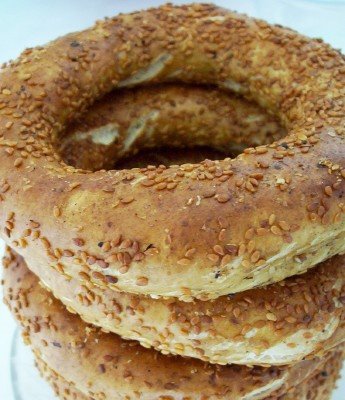
I wrote this paragraph to a group this morning. Then I decided to continue from here for the new update. At the beginning, I thought I could write more often but as time goes by, I realized that it takes more time and effort than writing in my own language. So each time I sat on my chair to write something in English, I found myself doing other things rather than writing for my English blog. I actually even found topics to write about. One was ‘simit’ (the round, crispy bread with lots of sesame seeds) which is one of the ‘staple’ foods (really!) for Turks. Simit-kasar-çay is like Daltons for us. You cannot seperate one from the other. Simit, I told about. You can see ‘simitçi’ (simit seller) on Istanbul streets. It can be eaten at any hour. For breakfast, for lunch, for afternoon tea, even for dinner! Kasar is our wonderful cheese which is somehow like gruyer or cheddar cheese but it’s different. Let me give you the explanation from Suzanne Swan’s wonderful book, The Treasury of Turkish Cheeses (Boyut Publishing, Istanbul, Turkey, 2004): “This is Turkey’s best-known and most popular cheese. It resembles a mild or medium Cheddar and they both have the same pale yellow colour and texture and gain their unique flavour after being left on shelves to mature over several months. Eski (Old) Kasar, produced in wheel-shaped moulds, mostly around Van and Kars. The cheese seller cuts off as much as you require.” Çay is of course, our beloved tea which can be drunk at an hour of the day, with or after the meals but especially for breakfast. In summer, tomatoes are wonderful additions for this trio.

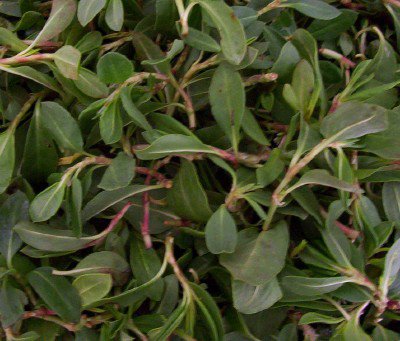
Yes, this was one of the subjects but I actually wanted to talk about the wonderful wild greens of Turkey. There is so much to tell about them. For my book A Tale of Wild Greens I researched on over 50 of them but if you go deeper and on regional scale, you can find easily over 200 edible greens.

Sometimes shoots are eaten, sometimes roots or leaves. You can either boil them and eat as a salad or fry or saute with onions and some other ingredients. Cooking the greens with bulghur (or rice) is another way of using them. You’ll see an example for this dish at the end of this post. Böreks are also special for Turks. So wild greens are used in many regions and in many different börek (phyllo dough dishes) recipes. You can add them in breads, cook with grains or legumes... There are so many ways of cooking them.

What are the most popular greens of Turkey? As I said there are so many of them but here I’ll name few of them: hodan (borage, borago officinalis), kusotu (chickweed, stellaria media), arapsaçi (wild fennel, foeniculum vulgare), yemlik (goat’s beard, tragopogon spp), kenger (milk thistle, onopordum or scolymus spp), madimak (polygonum cognatum), ebegümeci (mallow, malva silvestris), turpotu (white mustard, sinapis alba), tilkisen (wild asparagus, asparagus acutifolius), isirgan (nettle, urtica dioica), gelincik (poppy, papaver rhoeas), kuskus otu (shepherd’s purse, capsella bursa-pastoris), kuzukulagi (sorrel, rumex acetosa), hindiba (taraxacum officinale), köremen (wild garlic, allium spp)... These are only the few of a wide variety of greens. We also use oregano, thyme, sage, marjoram, laurel leaves both in cooking and to make herbal teas. They’re and so many other wild herbs and aromatic plants are used for healing too.

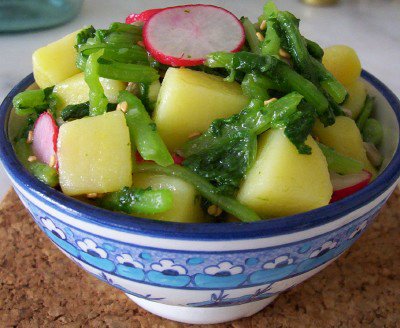
Since I cannot mention all of the uses and names, I wanted to keep it simple and give you an idea of what can be done with them. In A Tale of Wild Greens, I gave 153 recipes for how to use them creatively. As I said above, you can cook them in so many ways. Soups, starters, omelettes, main meals, breads, pastries, beverages and some alcoholic drinks, even sweets, pickles... What you need to do is to use your creativity. You can ask me for local uses of them if you wish. Here is the bulghur recipe with wild greens. You can use nettle, chickweed, wild fennel, goat’s beard, mallow, plantain as well as spinach, kale or chard or a combination of greens for this recipe:

Bulghur rice with wild greens (4-6 servings)

A big bunch of (approx a pound or half kilo) wild greens
2-3 leeks, cut in thin rounds
2 onions, cut in small pieces
1 ½ cups of bulghur*
3 cups of boiled water
3-4 tablespoons of olive oil or a tablespoon of butter
salt, pepper and red pepper

Heat oil in a pot, add onions and leeks. Saute them for 10 minutes on medium heat stirring once in a while. Add cleaned, washed and cut greens and cook for few more minutes. Then add washed and rinsed bulghur, hot water, salt, pepper and red pepper and cover the pot. Lower heat to very low and cook until all the water is evaporated. You can serve this meal with yoghurt or ayran** or with meats.
* You can find bulghur on health food stores or stores where Turkish or Middle Eastern ingredients are sold.
** Ayran is a summer drink which we love. It’s made with yoghurt, water and a bit of salt. All you need to do is to beat the ingredients until it becomes foamy. It’s preferred cold.